The Future of Global Travel Experiences
Travel is evolving from simply visiting destinations to creating personal, intelligent, and meaningful experiences. The future belongs to technology that adapts to travelers, connects digital and physical worlds, and helps people experience the world more intelligently and responsibly.
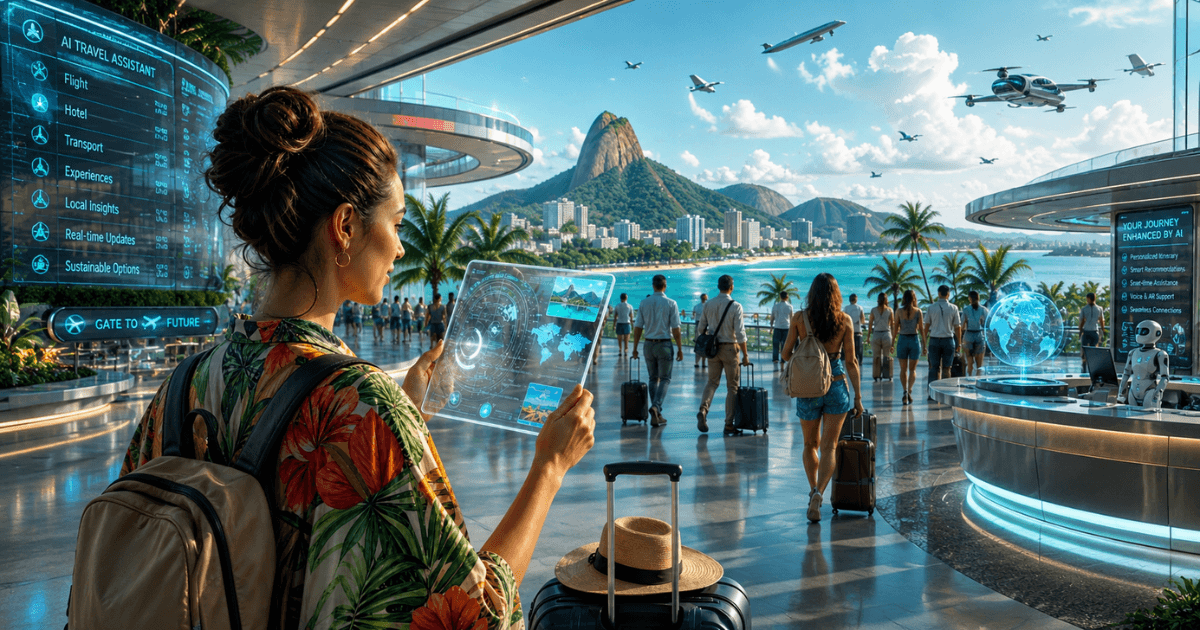
Travel is entering its next phase.
The scale alone is remarkable. In 2025, Travel & Tourism contributed US$11.6 trillion to the global economy, representing 9.8% of global GDP, while international visitor spending reached US$2.02 trillion. WTTC forecasts the sector to contribute around US$12 trillion in 2026.
But the next chapter of travel will not be defined only by how many people travel.
It will be defined by how they experience the world.
From Destinations to Experiences
Travel is moving beyond the traditional checklist of landmarks, hotels and attractions.
Travelers increasingly want experiences that feel personal, local and meaningful. Research on memorable tourism experiences has found that socio-cultural factors are particularly influential in shaping how travelers remember an experience, highlighting the growing importance of cultural connection and authenticity.
This changes the role of technology.
Technology should not simply help travelers find a destination.
It should help them understand it, experience it and connect with it.
The future traveler may not ask:
“What are the top 10 things to do here?”
They may ask:
“What would make this place meaningful for me?”
That is a fundamentally different travel experience.
Personalization Will Become the Baseline
The era of one-size-fits-all recommendations is disappearing.
Travelers have different interests, budgets, cultures, schedules and motivations. Technology is increasingly capable of understanding those differences and adapting experiences accordingly.
Industry research already reflects this shift. Amadeus reports that 85% of hoteliers surveyed identified personalization as a key driver of revenue growth, while technology investment by hoteliers was expected to increase by approximately 16% in 2025.
Personalization, therefore, is moving from a premium feature to an industry expectation.
The future experience will be less about presenting thousands of choices and more about presenting the right choice at the right moment.
The Journey Will Become More Intelligent
Travel does not happen in a controlled environment.
Weather changes. Flights are delayed. Roads become congested. Events sell out. A traveler discovers something unexpected and changes direction.
Static itineraries cannot respond to a dynamic world.
Artificial intelligence and predictive technologies can change this by allowing travel experiences to continuously adapt to context.
A recommendation can change because of the weather.
A route can change because of traffic.
An activity can be replaced because it is no longer available.
A traveler can discover something nearby that they would never have searched for themselves.
The experience becomes dynamic rather than predetermined.
The Physical and Digital Worlds Will Converge
The next generation of travel technology will increasingly blur the boundary between digital information and physical experience.
Augmented reality can add historical and cultural context to physical locations. Spatial computing can allow information to respond to the environment around the traveler. AI can interpret what the traveler is seeing and provide relevant information in real time.
This creates a new possibility:
The destination itself becomes an interface.
A monument can tell its story.
A street can reveal its history.
A neighborhood can become a discovery experience.
A museum can become interactive.
Technology no longer sits outside the journey. It becomes part of the way the destination is experienced.
Experience Must Also Become More Responsible
The future of travel cannot simply mean more travelers consuming more destinations.
It also has to mean smarter travel.
WTTC's latest environmental research found that Travel & Tourism's global greenhouse-gas emissions in 2024 were 9.3% lower than in 2019, while emissions intensity fell by 15% over the same period.
This creates an opportunity for technology to support better choices: distributing demand, encouraging lesser-known destinations, reducing unnecessary movement and helping travelers make more informed decisions.
The future is not about traveling less.
It is about traveling more intelligently.
The Experience Becomes the Product
The most important shift may be this:
Travel will increasingly be measured not by the number of bookings made, but by the quality of the experiences created.
The global travel economy is growing. Technology is becoming more intelligent. Destinations are becoming more connected. Travelers are becoming more demanding.
These forces are converging.
The future of global travel will therefore not belong simply to platforms that help people go somewhere.
It will belong to technologies that understand why they are going, what they want to experience, and how that experience can evolve along the way.
That is the opportunity ahead for the travel industry.
And ultimately, the future of travel is not about building a better way to book the world.
It is about building a better way to experience it.